Tuesday, May 25, 2010

Veils: An Illustrated Guide

To wear a veil or not to is the eternal question asked by brides the world over.  It really just depends on your own personal preference and style, and there really isn't a right or wrong answer.  If you do decide to wear a veil, here is a guide, featuring the lovely designs of Sara Gabriel, to help you through the decision making process. 

There are a few things to consider when choosing a veil- width, length, cut, color, and what types of embellishments you want.  I will explain each of these in greater detail below...

Width:
The width of the veil is determined by the width of the fabric before it is gathered.  Veils typically come in two standard widths- 108" and 72" wide.  Basically, the wider the veil, the poofier it will be.  Most veils are 108", but if you are going for a simpler look then the 72" size might be the way to go.  Veils can be made out of any width fabric, so if you want something even fuller than 108" or slimmer than the 72", then some veil companies will make custom changes. 

Length:
There are lots of different lengths to choose from when picking your veil.  The exact measurement differs based on your height, so they will either order a standard measurment (each company's are different) or they will do a custom measured length. 

Chin length
Chin length is most typically seen in a Russian or French netting style, but can sometimes also be seen in tulle (like the one pictured) and can be worn either as a blusher or as a veil.  It is best paired with sophisticated, minimalistic gowns.

Veil by Sara Gabriel, style "Drew"

Shoulder length.
Shoulder length is a lesser common style, but can still be really pretty.  It is best paired with less formal styles.
Veil by Sara Gabriel, style "Emma"

Elbow Length
Elbow length is a very common style.  It is best paired with gowns that don't have a lot of detail on the back of the dress and don't have a definitive waist seam, such as a plain mermaid or sheath style (like the style illustrated below).  The reason being the veil creates a line across your back and can detract from pretty details on the back of the dress and can also cut you off in a weird spot.
Veil by Sara Gabriel, style "Ava"

Fingertip Length
Fingertip length is a great length because it is a short style but doesn't cut you off like elbow length does.  It is also versatile as far as what styles it works best with.  It can be paired easily with simple or more formal styles, as long as it hits about an inch or so below the waist line of the dress.  Otherwise you run into the same issues as you do with elbow length.
 
Veil by Sara Gabriel, style "Jessica"

Knee Length
Knee length is another versatile length that works well with many styles of gowns.  It is long enough to not disrupt the details on the back of the dress, but short enough to be out of the way.  Just make sure that it isn't cutting off any of the pretty train details. 
Veil by Sara Gabriel, style "Sabina"

Floor Length
Floor length is great because you aren't cutting off the dress in a strange spot, but you can continue wearing it at the reception without it getting trampled.  It works fine with pretty much any style.
Veil by Sara Gabriel, style "Renee"

Chapel Length
Believe it or not, chapel length is actually one of the most versatile and flattering veil styles.  Because it hits an inch or two past the train, it doesn't compete with the back of the gown at all.  It blends right into the dress, allowing the pretty details on the back of the dress to show through.  It works great with any style, even less formal ones (just embellish the veil accordingly), just as long as the train of the dress is an inch or two shorter than the veil.
Veil by Sara Gabriel, style "Renee"

Cathedral Length
The same rules apply to cathedral length as chapel length.  It looks gorgeous with any style (including less formal styles), just make sure it hits at least an inch or two past the train of the gown.
Veil by Sara Gabriel, style "Carolina"

Cut:
The cut of a veil determines the way the veil hangs and looks.  There are tons of different cuts, but I'm going to focus on the major ones.

Classic Round
The classic round style is the most common style.  It is cut from a large rectangular piece of tulle with rounded bottom edges.  It can be made into any length.

Veil by Sara Gabriel, style "Grace"

Classic Square
The classic square is the same as the classic round, but the edges aren't rounded.  It can also be made into any length and looks great with any style gown.
Veil by Sara Gabriel, style "Katie"

Mantilla
The mantilla is a traditional European style that is cut from a oval shaped piece of tulle and isn't gathered.  Traditionally is is edged with lace trim, but can be plain or have other types of embellishments as well.  It can be made into any length and looks great with any style gown.

Veil by Sara Gabriel, style "Dahlia"

Cascade/ Waterfall
This style features an edge that ripples down.  It looks best with a simpler style gown because the veil's unique shape can detract from the gown.  Sometimes it's cut to look like it is two separate layers- one long and one short, like the "Ella" style below.

Veil by Sara Gabriel, style "Ella"

Veil by Sara Gabriel, style "Lena"

Veil by Sara Gabriel, style "Breanna"

Blusher
The blusher style is cut a few different ways, and it is pinned to your hair to cover your face.
Veil by Sara Gabriel, style "Collette"

Color
Veils typically come in at least white and ivory, but usually more colors too.  The key is to try and match the color of your veil to your gown exactly.  Ignore the color names because everyone's version of color is different.  Instead hold veil swatches up to your dress and go from there.  If there isn't an exact match, then go with the veil color that is a shade darker.  Never go lighter with the veil color or else your gown will look dirty.

Embellishments
There are a number of different ways to embellish a veil.  It all just depends on how detailed your dress is and what your tastes are. 

Lace
Lace is gorgeous, but can be a bit overwhelming.  It looks best with lace gowns or more plain styles, but can also work with detailed gowns too, it just depends on your taste.


Alencon lace veil by Sara Gabriel, style "Kristen"

Rhinestones
Rhinestones add sparkle to your veil.  Make sure you choose a company that puts rhinesones on each side of the tulle, back to back.  Otherwise you see the glue on the other side- not pretty.

Rhinestone embellished veil by Sara Gabriel, style "Karen"

Pearls
Pearls add a pretty, classic touch to your veil.  The also look great combined with rhinstones and crystals.
Pearl detailed veil by Sara Gabriel, style "Audrey"

Soutache trim
Soutache is a braided trim that adds a level of elegance to veils.  It best matched with a simple style gown.
Soutache trimmed veil by Sara Gabriel, style "Ava"

Veils can also be trimmed with ribbon or have a "pencil edge" using fine tread.  Anytime you have a thick edge, it can sometimes create a frame around you, so they are typically best paired with a simpler gown.

So what's the deal with blushers?
A blusher is a layer of tulle that folds over your face and gets put to the back during the ceremony.  It is completely a matter of personal preference whether or not to have one.  Alot of times the longer layers of the veil are made detachable, so you just have the short blusher layer for the reception. 

{All images via Sara Gabriel}

Have other questions about veils?? Feel free to ask in the comments sections!!

-A

Related Posts:

Monday, May 24, 2010

My Top Ten Gorgeous Movie Brides

A week or two ago my friend shared a link with me featuring the top ten most beautiful movie brides and so  I've decided to compile my own list of gorgeous, memorable movie weddings.  I included a few from the original list, but I've also added a few of my own.  Take a look and be sure to add your favorites that I missed in the comments section below!

1. Kirsten Dunst in Marie Antoinette, 2006

From the meticulously coiffed hair to the several feet wide pannier skirt, everything about this wedding screamed royalty.  Très magnifique!

...
2. Gwyneth Paltrow in Emma, 1996

Even though Mrs. Elton quips that the wedding had a "shocking lack of satin", Emma Woodhouse's simple regency wedding gown is still lovely even by today's standards. 

...

3. Sarah Jessica Parker as Carrie Bradshaw in Sex and City: The Movie, 2008

Carrie Bradshaw is equally stunning in both her original Vivienne Westwood wedding gown and aqua feathered headpiece, and in her thrift store suit and blue and crystal Manolos, once again showing she is just as at home in haute couture as she is in vintage, which is why we fell in love with her in the first place. 

...
4. Mae Clarke in Frankenstein, 1931

Look familiar? That's because I featured these pics in my Silent Screen Vamps post two weeks ago, but I couldn't resist including Mae Clarke's amazing gown and veil one more time.

...
5. Audrey Hepburn as Jo Stockton in Funny Face, 1957

Even though she wasn't actually a bride in this movie (she played a model on a  location shoot in Paris), she is beautiful just the same.  Her quinessential 1950's silhouette gown and veil were designed by Hubert de Givenchy, Hepburn's personal and professional couturier.  And seriously, how many women can pull of that harsh 1950's makeup and not look overdone? 

...
6.  Reese Witherspoon as Melanie Carmichael in Sweet Home Alabama, 2002

The simplicity of her trumpet gown and Russian netting veil creating a gorgeous look that is timeless and still relevant 8 years later.

...

7.  Talia Shire as Connie Corleone and Simonetta Stefanelli as Apollonia Vitelli in The Godfather, 1972


This movie featured not one but two beautiful Italian weddings.  The first was the marriage of Connie Corleone (the godfather's only daughter) to wife-beater extraordinaire Carlo Rizzi.  The second was the marriage of lovely donna Siciliana Apollonia Vitelli to Michael Corleone and his black eye.  Even thought the two weddings took place on separate continents, both brides wore gorgeous lacy confections with traditional European mantilla veils.  Belissima!

...

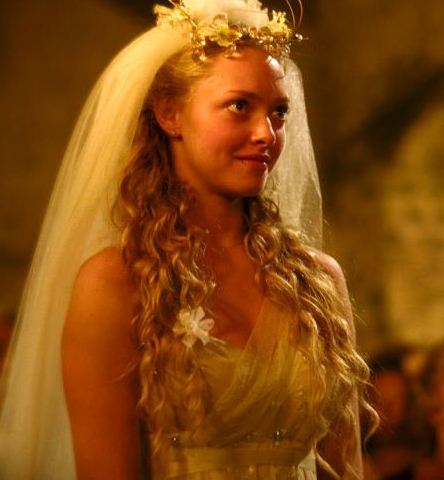
8.  Amanda Seyfried as Sophie in Mamma Mia!, 2008

Perfect for a seaside wedding in the Greek Isles, her flowy dress, laurel headpiece, and mermaid hair are downright goddess worthy!

...
9.  Robin Wright Penn as Princess Buttercup in The Princess Bride, 1987

Her renaissance ensemble has been the inspiration for many brides since the movie debuted in the late '80's, and for good reason- she's stunning!

...
10. Kimberly Williams-Paisley as Annie Banks in Father of the Bride, 1991

In the middle of the late 80's/early 90's excess, her wedding gown showed marvelous restraint featuring a simple veil and gorgeous Chantilly lace dress.

{Images via Google}

I know there are tons more gorgeous movie brides, so tell me your favorite in the comments section below!!

-Alessandra

Related Posts:

Thursday, May 20, 2010

Real Vintage Wedding: Frank and Carmela late 1920's


This is a photograph of the wedding of Frank and Carmela Spremulli, who are my great-great uncle and aunt on my dad's mom's side.  I am not exactly sure of when it took place, but I know that was somewhere between 1926 and 1929.  Even though I really don't have any details about this wedding, it is still such a great photo and I wanted to share it.  It was quite the big Italian wedding!

My great grandparents, Leonardo and Isadora, are in the back row second and third from the right.  My great uncles Frank and Eligio are in the middle row on the far right.  My grandma Judy (who I will feature in another real vintage wedding post) wasn't born yet.  I wish I had a better photo of the bride's dress, buta aren't her veil and bouquet so cool? Love!!

Couple: Francesco and Carmela Spremulli
Location: Ohio
Date: Late 1920's

Thoughts?? Post in the comments section!!

Have photos from a real vintage wedding?? Then submit them!!

-Alessandra

Related Posts:

Wednesday, May 19, 2010

A Guide to Recognizing Your Fabrics

It's very important (in my opinion anyways) to know at least a little bit about fabric before you go shopping for wedding gowns/ maids dresses/ mom's dresses etc.  Most assume that the price of a dress is mainly based on the how much detail it has (embroidery, beading) but that's not totally true.  Fabric actually has a much greater impact on the price of a dress.  Because most dresses are made by machine in far away places like Taiwan or China, they really don't cost very much to make because the labor costs are (sadly) so cheap.  The materials, along with the complexity of the design, are actually what really drive the cost up. A dress that is made of polyester satin and covered in embroidery and beadwork will still most likely be less expensive than a dress made of silk satin with no embroidery or beadwork because silk satin is really expensive.  There are pros and cons to different types of fabric, so it really just depends on what your looking for and how much you want to spend.  Being a fabric junkie, I am partial to richer fabrics but everyone is different.  So, here is The Ethereal Bride's handy fabric guide to hopefully help you make sense of the big sea of white that lays before you. 

First of all, there are two aspects of fabric that you need to understand- how it's made and what it's made of.  How it's made refers to whether or not it's knit or woven and what type of knit or weave it is.  Typically, most special occasion fabrics are woven, except for some stretch jersey, so I'll just focus on that.  The way a fabric is woven determines how it feels to the touch and how it flows on the body.  Some examples of different types of weaves are satin, taffeta, and organza.  What it's made of refers to what type of fibers were used to make the fabric.  Some examples are cotton, silk, acetate, linen, and polyester.  Sometimes a combination of fibers is used such as a silk/cotton blend.  Below, I will discuss the most common fabrics in greater detail.

Polyester Satin
Most people have horrible 1970's flashbacks when they think of polyester, but it's actually super versatile and probably the most common fabric used in the bridal industry.  Shocking, I know.  Poly satin is a super common satin because it looks very similar to silk satin but is way less expensive, more wrinkle resistant, and way less delicate.  Keep in mind, there are many different quality levels of poly satin.  There is a difference between a $99 poly satin gown and a $1900 one.
Pros: Less expensive than silk, more wrinkle resistant than natural fabrics, comes in any color, durable
Cons: Not as rich looking or feeling as silk satin, heavy and can be hot to wear
Best time of year to wear: Fall, winter or spring, however, it can defintely be worn in summer also just note that you may get overheated during an outdoor ceremony or photos. 
Polyester satin gown by Allure Bridals; style# 8759

Polyester Chiffon
Like poly satin, poly chiffon is the most common type of chiffon in the bridal market.  It is characterized by it's sheer, flowy look. 
Pros: Less expensive than silk chiffon, lightweight, comes in any color
Cons: Wrinkles easily but not as easily as silk, delicate
Best time to wear: During warmer weather months
Polyester chiffon gown by David's Bridal; style# 9743

Taffeta
Taffeta is often made of a number of different fibers- nylon, acetate, silk or polyester.  It is characterized by it's swishy and sometimes wrinkled texture.  The stiffer the taffeta, the better the quality.  To test the quality, scrunch a handful of the fabric, if it stays somewhat scrunched then it is good quality, if it springs back to being flat, then it is of lesser quality.  Unlike other synthetic fabrics, certain synthetic taffetas are sometimes even better quality than silk taffeta, such as the Enzoani style featured below.
Pros: Lightweight, looks good if it's a little wrinkled, can come in any color, durable, synthetic varieties can be less expensive than silk (but not always), because of the way it's woven it can come in iridescent (almost two tone) colors
Cons: Not as lustrous as satin, some don't like the "swish" sound it makes
Best time of year to wear: Taffeta is perfect anytime of year because it's rich enough for winter months but lightweight enough for the hottest months
Iridescent crinkle taffeta dress by Bari Jay; style# 933
Nylon taffeta gown by Enzoani; style "Brie"
Silk taffeta gown by Jasmine Couture; style# T939

Silk Satin
Silk satin (sometimes referred to as peau de soie or duchesse) is probably the richest fabrics due to it's lustrous appearance and buttery soft feel.  Unfortunately, it is also one of the most expensive.  Just to give you a little perspective of just expensive silk satin is- at my local fabric retailer silk taffeta costs $25 per yard whereas the silk satin costs $75 per yard.  However, in my esteemed opinion, it's worth every penny. 
Pros: Very luxurious look and feel, much more lightweight than poly satin
Cons: Very expensive, not as durable as poly satin, heavier than some other fabrics, like all silk fabrics it can't come in stark white because silk can't be safely bleached without ruining the integrity of the fabric
Best time of year to wear: Probably best in cooler monts but can be worn anytime of year, just be aware that you may become overheated during outdoor summer ceremonies
Silk duchesse satin gown by St. Pucchi; style# 9322

Silk Organza
Organza is basically a stiffer chiffon; it is just as sheer but not really flowy.  It also comes in poly or nylon, but I am only going to talk about silk organza because it is much more common and many of the properties are similar. 
Pros: Luxurious, lightweight,
Cons: Wrinkles easily, delicate, expensive but not as expensive as silk satin
Best time of year to wear: Typically during warmer months, however, can really be worn anytime of year
Silk organza gown by James Clifford; style# J11009S

Dupioni Silk & Silk Shantung
Dupioni silk and silk shantung are very similar fabrics, so I'm just going to lump them together.  They are both a plain weave using raw silk yarns (other silk fabrics' yarns are processed to give them their silky texture), the only difference between the two is that the yarns used in dupioni silk are "slubbed", which means the yarn's thickness is inconsistant, creating a uniquely textured fabric.
Pros: Fairly lightweight, rich look and feel, comes in lots of gorgeous bright colors, maintains volume without lots of crinolines underneath 
Cons: Wrinkles pretty easily, expensive, some don't like the "raw" texture
Best time of year to wear: Anytime of year because it is lightweight enough for warm months but rich enough for cold months
Verbena silk shantung dress by Watters; style# 4912
Midori dupioni silk dress by Watters; style# 6456

Silk Charmeuse
Silk charmeuse, also sometimes referred to as "crepe backed satin" is a form of silk satin, but is super thin and flowy. It is primarily used in body conscious styles with lots of draping. 
Pros: Super luxuious feel and look, less expensive than silk satin, drapes and flows really easily
Cons: Very delicate, more expensive than synthetic fabrics,
Best time of year to wear: Warmer months but can work during cold months because of it's rich appearance
Silk charmeuse gown by Vera Wang; style "Cassandra"
Silk charmeuse dress by Melissa Sweet; style# MS321


Tulle
Most people know tulle as the fabric commonly used in tutus, but it is also used in wedding gowns as well.  It is characterized by it's stiffness, sheerness, and ability to create really full skirts.  It is typically made of nylon but can also made of silk. 
Pros: Lightweight, fairly inexpensive, hides wrinkles fairly well
Cons:  Delicate, too poofy for some tastes, not as rich looking as other fabrics
Best time of year to wear: Anytime of year
Flower girl dress with tulle skirt by Johanna Grace; style# "Arabesque"

Tulle gown by Impression; style# 3073

Silk Chiffon
Silk chiffon (also known as silk mousseline or silk crinkle chiffon) is very similar to synthetic chiffon.  It is sheer and very lightweight.
Pros:  Lightweight, soft texture
Cons: Very delicate, expensive, some don't like it's raw texture
Best time of year to wear: Warm months
Silk mousseline dress by Watters; style# 4017B

{Images via their respective websites}

Want to know what the deal is with other fabrics?? Ask me in the comments section below!!

LinkWithin

Related Posts with Thumbnails